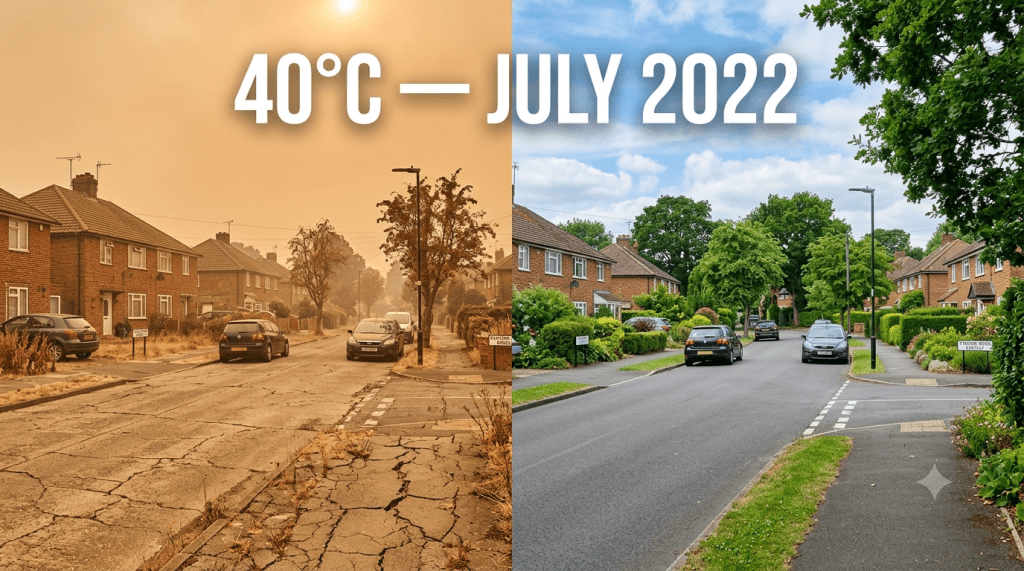
The summer of 2022 was unlike anything the United Kingdom had experienced in recorded history. On 19 July 2022, temperatures in England exceeded 40°C for the very first time, with Coningsby in Lincolnshire recording 40.3°C. It wasn’t just a statistic — it was a turning point that changed how millions of homeowners think about the comfort and safety of their own homes.
What Actually Happened in July 2022?
The heatwave was caused by a plume of exceptionally hot air drawn northward from North Africa and the Iberian Peninsula. Temperatures that would be considered extreme even in southern Spain arrived over a country where homes, offices and schools are built almost entirely to retain heat rather than release it.
The consequences were severe. Network Rail cancelled hundreds of train services as tracks buckled. Roads melted. Hundreds of wildfires broke out across London and Essex. The London Ambulance Service declared a major incident. The UK Health Security Agency declared a Level 4 heat emergency — the highest possible level — for the first time ever.
Most significantly for homeowners, the indoor temperatures in many British homes became genuinely dangerous. Bedrooms reached temperatures where sleep was impossible for days. Loft rooms regularly exceeded outdoor temperatures. The elderly and very young were at serious risk.
Why UK Homes Struggled So Badly
British homes are built for a different climate. Cavity wall insulation, double glazing and well-insulated roofs are designed to keep heat in during our typically cool winters. During an extreme heatwave, these same features become a liability — trapping heat inside with no way to release it.
Continental European countries with similarly hot summers have long since adapted their building stock. Shutters, thick stone walls, and in many cases air conditioning are standard. In the UK, air conditioning in residential properties remains rare — though that is changing rapidly.
The Shift in Attitude Towards Air Conditioning
Before July 2022, many UK homeowners viewed air conditioning as an unnecessary luxury — something for hotel rooms and offices, not family homes. The heatwave fundamentally changed that perception.
In the weeks following the record temperatures, enquiries for residential air conditioning installation across Hertfordshire, North London and Essex increased dramatically. Homeowners who had spent years dismissing the idea suddenly found themselves unable to sleep in their own bedrooms and unwilling to experience the same situation again.
The data supports this shift. The Air Conditioning and Refrigeration Industry Board reported significant growth in residential AC installation across the UK in the years following 2022, with the South East and Home Counties seeing some of the highest demand.
What 2022 Taught Us About Home Comfort
The events of that summer revealed several important lessons for UK homeowners:
- A fan moves hot air around — it does not cool a room. When outdoor temperatures exceed 35°C, a fan provides almost no meaningful relief.
- Opening windows at night only helps when outdoor temperatures drop significantly — during the 2022 heatwave, overnight temperatures in parts of Hertfordshire remained above 25°C.
- Modern well-insulated homes actually perform worse in extreme heat than older draughty properties, because there is no way for heat to escape.
- The health impact of sustained high indoor temperatures is significant, particularly for those over 65, young children, and anyone with cardiovascular or respiratory conditions.
Will It Happen Again?
The science is unambiguous. The Met Office has confirmed that heatwaves of the 2022 type are now significantly more likely due to climate change, and that the UK should expect temperatures above 40°C to occur more frequently in coming decades. The 2022 event was not a once-in-a-generation outlier — it was a preview of what future UK summers will regularly bring.
The Practical Response for Hertfordshire Homeowners
The most effective and permanent solution to extreme indoor heat is a properly designed and installed air conditioning system. Modern inverter-driven systems from manufacturers such as Daikin, Mitsubishi Electric and Samsung are quiet, energy-efficient, and capable of cooling a room from 35°C to a comfortable 22°C within minutes.
Unlike the improvised solutions many homeowners reached for in 2022 — portable air conditioning units, industrial fans, wet towels — a properly installed split system provides reliable, consistent comfort without noise, without inefficiency, and without the need to wait until the next heatwave to act.
At All Season Air + Energy, we install air conditioning systems across Hertfordshire, North London, Essex and Bedfordshire. If you’d like to ensure your home is prepared before the next heatwave arrives, contact us today for a free survey and estimate.
p>
 allseasonairenergy
Leave a comment